A Program, Not a Phone Number
If a CFO or GC asks "what is our international travel security program?" and gets the answer "we call this vendor when something happens," the company doesn't have a program. Duty-of-care obligations, board-level oversight, and the realities of 2026 travel risk demand more than that.
A real international travel security program has six documented components.
1. Country Risk Tiers
The program assigns every country an employee may visit to a tier in advance: Green, Yellow, Orange, or Red. Those assignments get a quarterly review against State Department guidance, in-country incident reporting, and the company's own travel history. Every other part of the program follows from these tiers.
2. Pre-Trip Approval Workflow
Approval follows a different path for each tier. Green requires manager notification only. Yellow calls for travel risk acknowledgement and a pre-trip briefing. Orange requires a pre-trip threat brief, security desk approval, and an in-country support arrangement. Red requires C-suite or board-designated approval, mandatory in-country support, and documented business justification.
The company's existing travel system contains this workflow directly, rather than leaving it as a separate process that travelers will try to bypass.
3. Traveler Training and Briefing
Annual baseline travel-security training is required for every employee who travels internationally. Anyone traveling to an Orange or Red destination also receives a destination-specific brief within 72 hours of departure.
4. In-Country Support
Country tier and traveler profile determine the level of in-country support, which ranges from a 24/7 emergency line to full close protection and secure transportation. Providers are named in advance, with contract terms pre-negotiated and direct contact available to the company's GSOC or designated owner.
5. Crisis Response
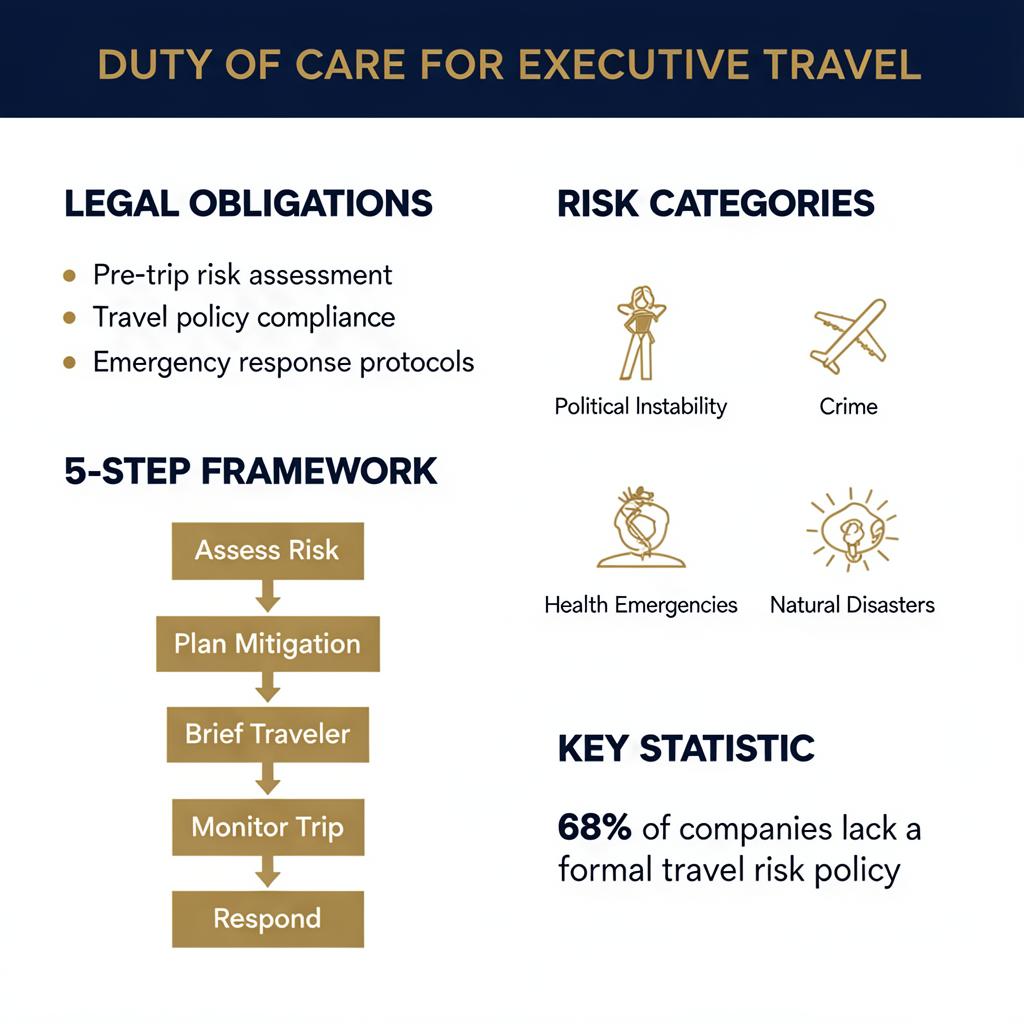
The documented crisis-response plan assigns specific roles and individuals rather than naming a department. Rehearsed annually, it covers communication, family notification, government coordination, evacuation, and PR / legal coordination.
6. Duty-of-Care Evidence
Documentation comes out of every step: completed trainings, delivered briefs, granted approvals, engaged support, and logged incidents. For duty of care, those records form the program's evidence base for both board oversight and post-incident review.
What a Good Program Avoids
- A vendor list with no workflow.
- Country tiers that have not been reviewed in twelve months.
- Approval workflows that travelers route around.
- An "in case of emergency" plan that has not been rehearsed.
- Incidents that are remembered but not documented.
AMERINE's Role
We work with corporate security and risk teams to design, document, and operate international travel security programs, starting with initial design and continuing through ongoing in-country support across multiple regions. You can engage us for a focused program-design sprint or an ongoing GSOC and in-country support partnership.
Contact us to discuss program design.
---
This article is general corporate-security program guidance. It is not legal, HR, or compliance advice. Program design should be coordinated with the company's GC, HR, and risk leadership.