Reactive Travel Security Repeats the Same Work Twice
For most family offices, the shortage isn't security judgment. It's lead time. Trips get built around a deal, a school calendar, or a family event, with security brought in only after flights are ticketed and hotels confirmed. By then, every protective decision means correcting a commitment instead of following a plan: rebooking a hotel, finding a driver under time pressure, squeezing an advance into a single day, or accepting whatever short-notice coverage is available in that city.
The security posture itself is rarely the problem in family office travel. The trouble comes from rework, tight timelines, and commitments made before anyone evaluates them. Planning won't remove risk, but it reduces the rework needed to manage it.
Inside a family office, you may be managing trips as the chief of staff, the principal's executive assistant, the family office COO, or the security director coordinating outside providers.
Before Travel: Decide Ownership, Not Just Logistics
Bad tradecraft rarely causes a travel security plan to fail. The failure comes from leaving ownership undefined. Get written answers to four questions before anyone finalizes the itinerary.
Who approves the itinerary from a security standpoint? Put one person in charge and spell out what triggers their review: any international leg, a destination new to the family, minors traveling without a parent, or any publicly announced appearance.
Who is the single point of contact during the trip? Assign one accountable contact for the family and one for the provider. Nothing drops critical instructions faster than parallel communication channels.
What triggers escalation, and to whom? Set the list before travel begins: a medical event, a missed check-in, a credible threat or unwanted approach, civil disturbance near the party, a transport breakdown, or a privacy breach.
What does the family actually want? Before departure, talk through discretion, visible protection, vehicle posture, and the detail the principal wants to hear compared with what the team handles quietly. Set those expectations as a discussion about preferences, not a debate about security.
The pre-travel work product
Before departure, someone needs to put their name on a written assessment. At minimum, it must cover:
- Destination posture: the local security, political, and public-health environment, along with risks specific to the principal's profile or visibility. Read current advisories directly instead of skimming summaries. Our country travel security index organizes destination-level context.
- Arrival and departure choreography: terminal or FBO selection, greeting protocol, customs and immigration clearance, and the plan if arrival slips by several hours.
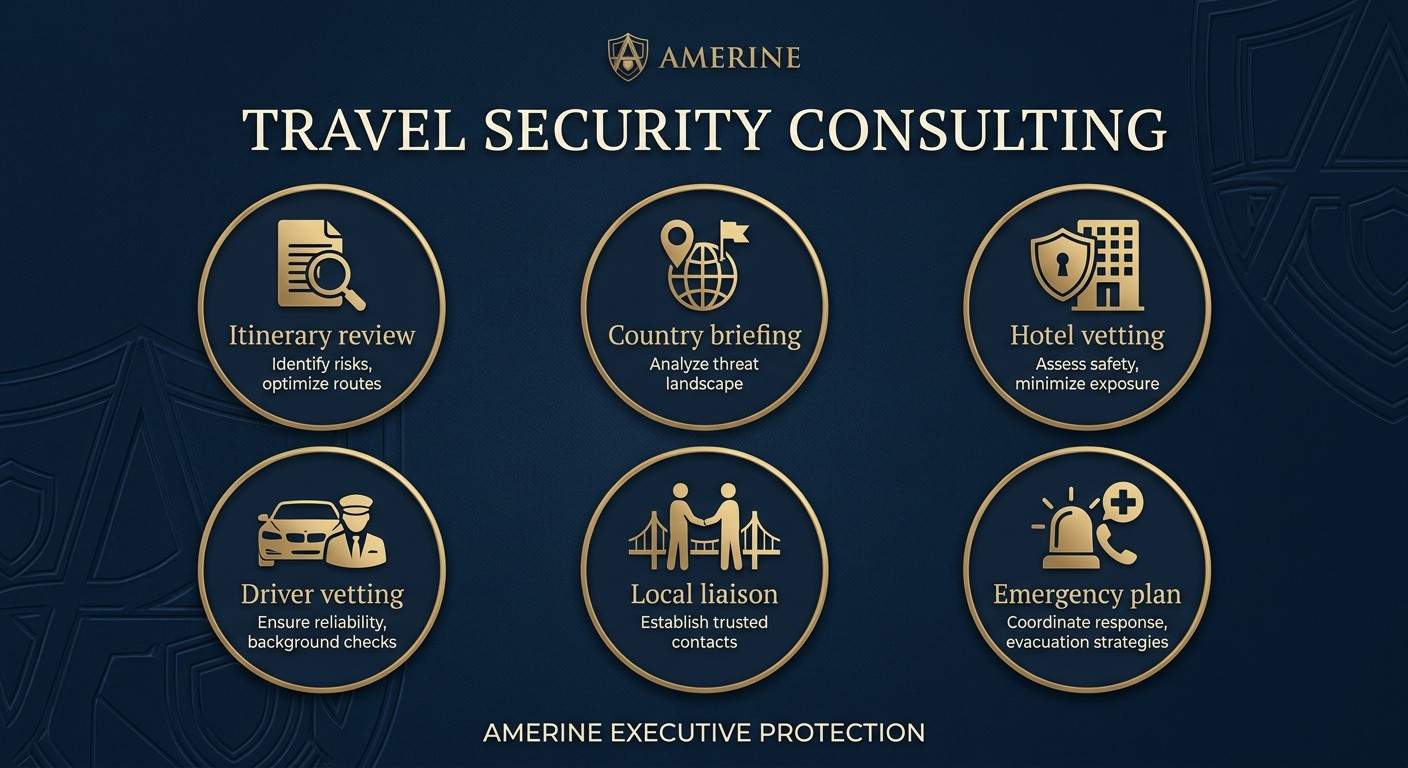
- Accommodation review: physical security at the hotel or residence, lobby and arrival flow, floor and room selection logic, and a vetted backup property if the primary site falls through.
- Ground transport: vetted drivers, inspected vehicles, primary and contingency routes, and schedules built on realistic traffic windows instead of best-case assumptions.
- Daily exposure plan: venue-by-venue reviews for meetings and restaurants, noting where the principal's movements become predictable.
- Medical and contingency: detailed below, and consistently the section teams skip.
- Communications discipline: which channels handle sensitive information, what never goes in writing, and device security rules for the destination.
- Family-specific briefing: separate briefs for the principal, spouse, older children, and traveling household staff, tailored so each person actually reads and understands them.
Itinerary Change Ownership: The Part That Breaks
On almost every trip, the itinerary changes. A meeting shifts, dinner gets added, a child wants an unplanned outing, weather shuts an airport, or the principal changes their mind at 7pm. What matters is who can approve the change and who needs to hear about it.
Write this down before departure:
- Who can approve a change in the moment. Usually the principal, but the practical answer is often the chief of staff or the detail lead acting on standing guidance.
- What changes require a re-look before they happen. New venue in an unassessed area, unplanned public appearance, change of city, any split of the party into two groups, or any movement outside pre-planned transport.
- What changes are simply communicated. Timing shifts, restaurant swaps inside an already-assessed area, or an additional passenger already vetted.
- How the change is communicated. One channel, one confirmation back. A change that no one acknowledged is not a change; it is a gap.
- What the fallback is if the change cannot be supported. Sometimes the honest answer is a delay of thirty minutes, a different venue, or a reduced-exposure version of the same plan. Agreeing in advance that this answer is acceptable is what makes it usable at the time.
Set a separate rule for splitting the party. When one parent heads to a meeting and the children leave for an activity, the plan needs to cover both groups, rather than the principal alone. The group that wasn't supposed to be moving accounts for most unplanned exposure in family travel.
Provider Coordination: One Plan, Not Several Vendors
Several parties usually support family office travel: an aviation provider or charter broker, ground transport, the hotel's in-house security team, an in-country protective detail, and often a medical evacuation membership. They may each be competent at their own work. None, though, owns the whole trip.
Coordination practices that hold up:
- Name one coordinating party who holds the master itinerary and briefs the others on a need-to-know basis.
- Brief local providers on posture and preference, alongside times and addresses. A driver who does not know the family prefers zero visible security will behave in a way the family notices immediately.
- Confirm credentials and licensing in the operating jurisdiction, and verify what the local provider is legally permitted to do there. Legal authority for protective work varies significantly across borders.
- Agree on a reporting cadence before departure: establish a check-in rhythm, a clear format, and a single recipient, so that silence is meaningful rather than ambiguous.
- Define the handoff points between providers. Aircraft to ground, ground to hotel, hotel to venue. Incidents cluster at these seams.
- Scope and terms are confirmed in writing. Contingencies must cover standby vehicles, an extra night, and a re-routed flight.
Coordinating that work is a large part of our travel risk management practice, so the family office doesn't have to manage five separate vendors in real time.
Medical Contingency Planning
On family trips, medical events occur far more often than security incidents, yet medical contingencies are the ones most often left generic. To be usable, the medical plan needs to be written down and specific to the destination.
- Identified facilities. Which hospital, by name, for a serious event, and which clinic for a minor one. Facility quality varies enormously inside the same city.
- Evacuation coverage. Whether an evacuation membership or insurance policy is in force, what it actually triggers on, who calls it, and what the policy number is. A membership no one can locate during an event provides nothing.
- Routing. Where a patient would be moved to if local care is not adequate, and how long that takes from the destination.
- Medications and records. Current medications, dosages, allergies, and conditions carried in a form the travelling party can hand to a clinician, with attention to the legality of specific medications at the destination.
- Consent for minors. Written authorization for a travelling guardian or staff member to authorize treatment for a child, where the family's counsel advises it.
- Language. Who translates.
Make these decisions before departure, and the medical plan fits on one page in the brief. Leave them until an event is underway, and the decisions become the event.
Privacy of Itineraries
Nothing produced during trip planning is more sensitive than the itinerary details. Yet those details too often get emailed to a dozen people who don't all need the full picture.
- Distribute by need to know. Assistants, drivers, and outside vendors only need their specific pieces, not the complete schedule.
- Avoid a single master file circulating widely. If a full itinerary exists, keep it to a small, confirmed distribution list.
- Keep the principal's name out of vendor-facing bookings where the family's structure allows it, and coordinate that choice with counsel and the family office.
- Brief the traveling party on social posting. Real-time posts by family members, guests, or staff are the most common source of location disclosure, often after the security plan was otherwise sound. Agreeing on a delay convention is usually enough.
- Manage staff channels. Group chats used for logistics function as itinerary distribution systems. They deserve the same scrutiny as an email list.
- Close out access afterwards. Shared folders and chat groups created for one trip should not remain open indefinitely.
During Travel: What Good Looks Like
- A defined check-in cadence that both sides honour, so that a missed check-in means something.
- One channel for change traffic, with acknowledgement.
- A short daily look-ahead: what is planned tomorrow, what changed, and what needs a re-look.
- Discreet posture by default, with the family's preference respected unless conditions change.
- A documented decision anytime the plan is departed from, even briefly. It takes a sentence.
After Travel: The Step Almost Everyone Skips
A short debrief within a week is the highest-return, lowest-cost part of the whole cycle.
- What actually changed versus the plan, and why.
- What worked: providers, routing, timing, accommodation.
- What was uncomfortable for the family, which is different from what was unsafe.
- What would have benefited from more lead time.
- What should be standing guidance for the next trip to that destination.
Keep even a one-page record of each trip, and within a year your family office builds a destination library of known providers, hotels, timings, and preferences. With that library, planning the next visit to the same city takes a fraction of the effort.
Understanding Scope Drivers
Travel security is shaped by structure. The key factors:
- Lead time. Short-notice sourcing limits provider choice and removes the option of a proper advance.
- Number of moving parts. Parties that split, multiple cities, or multiple vehicle movements per day each multiply coverage.
- Advance work. Whether venues and routes are assessed in person before use.
- Destination conditions. Local provider availability, licensing environment, transport reliability, and medical infrastructure.
- Posture. Discreet single-officer coverage and a multi-vehicle profile are different programs.
- Contingency depth. Standby vehicles, secondary accommodation holds, and evacuation arrangements provide optionality.
A missed meeting, a cancelled leg, a night in the wrong city, or privacy exposure that lasts beyond the trip all carry a cost. Planning won't eliminate these disruptions. It does turn most of them into decisions rather than emergencies.
Scope and terms are confirmed in writing. We will tell you which of the drivers above apply to your specific trip.
A Practical Pre-Trip Briefing Checklist
Use this as the agenda for a thirty-minute call before any significant trip.
For ownership, name the itinerary's security approver, establish a single point of contact on the family side and provider side, define escalation triggers and their recipient, and set standing authority for in-the-moment changes.
For the trip picture, receive and read the written destination assessment, confirm arrival and departure choreography, review accommodation and identify an alternate, confirm ground transport and routes with a contingency, and review the day-by-day exposure plan.
For the people traveling, deliver the brief to the principal, spouse, children, and traveling staff, and agree on party-split rules and a social posting convention.
For medical arrangements, identify facilities by name, confirm evacuation coverage and make sure it's reachable, carry medications, allergies, and records, and put consent arrangements for minors in place.
For coordination, brief all providers on their responsibilities, confirm credentials and local authority, agree on reporting cadence and format, define handoff points, and agree on contingency authority.
For privacy, limit itinerary distribution to those who need to know, decide the approach to booking names, and close out access after the trip.
Frequently Asked Questions
How far ahead should a family office start travel security planning?
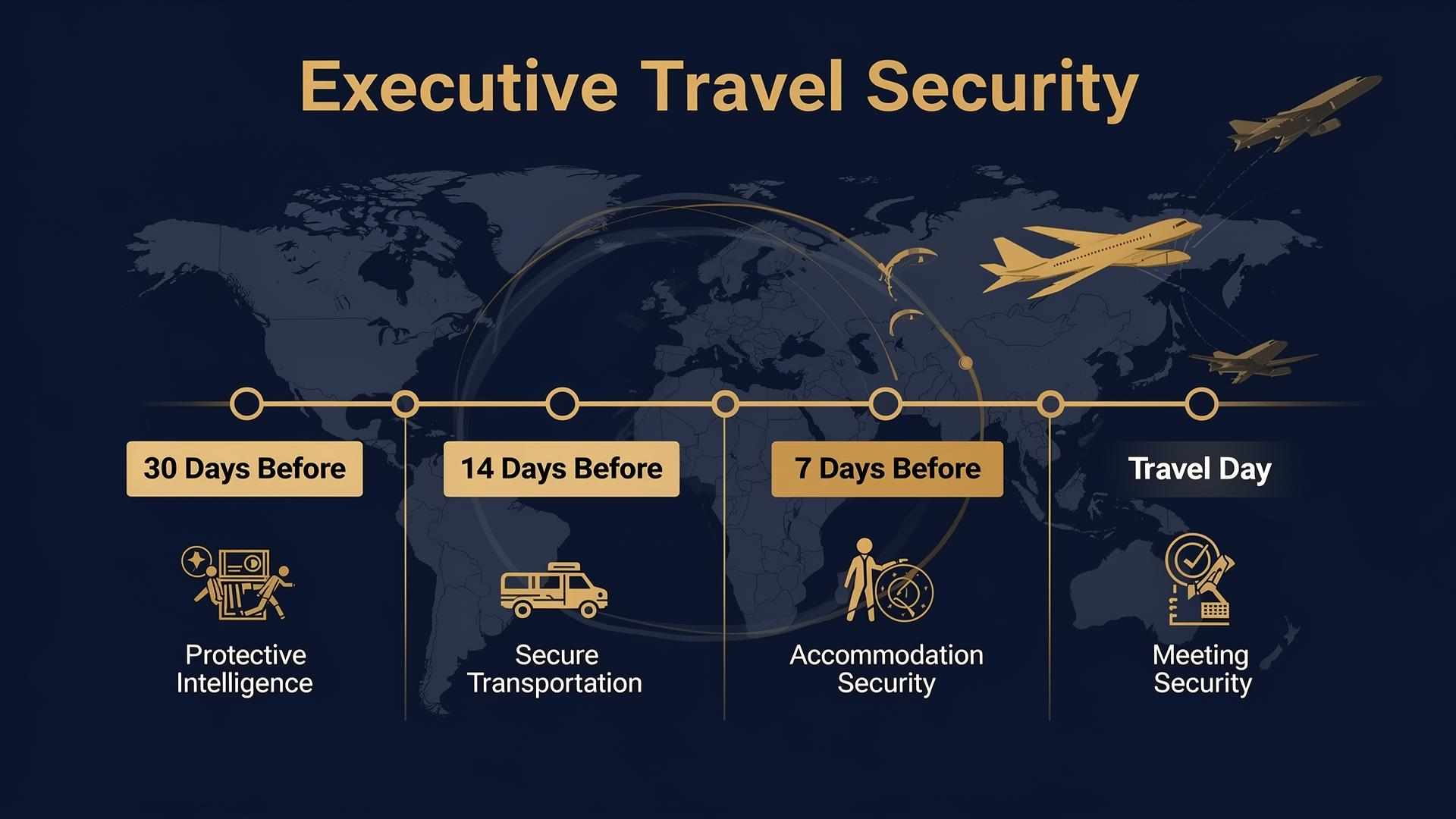
Earlier than feels necessary. For familiar destinations with an established provider, a couple of weeks is usually workable. For a new destination, a complex multi-city itinerary, or travel involving minors or a public appearance, start as soon as the dates are firm, before flights and accommodation are locked, because those two choices constrain everything else.
Who should own itinerary changes during a trip?
One named person on the family side with standing authority, paired with one accountable contact on the provider side. What matters more than the title is that the rules are written before departure: which changes can be made in the moment, which need a re-look, and how a change is confirmed back.
Do we need protective coverage on every trip?
No. Many family office trips need planning, a written assessment, and vetted ground transport rather than a protective detail. The useful question is not whether to bring security, but which parts of the trip carry real exposure and what the proportionate response to those parts is.
How do we keep an itinerary private when so many people need pieces of it?
Distribute by portion rather than circulating a master document, keep the full itinerary to a short known list, agree a social posting convention with the travelling party, and close shared folders and group chats when the trip ends.
Working With AMERINE
We handle the assessment, provider coordination, and single point of contact so your family office doesn't have to manage the trip in real time. Led by founder Scott Jones, trip support includes a written assessment with a named author and a defined reporting cadence during travel.
Request a private consultation or call (281) 799-1877 to discuss an upcoming itinerary.
See also: Travel Risk Management and our country travel security index.
---
This article is general travel-security guidance. It is not legal or medical advice. Each trip should receive an assessment calibrated to specific destination, principal, and exposure profile.