Why Corporate Event Security Demands a Different Approach
Corporate events — from shareholder meetings and board retreats to industry conferences and executive galas — create a concentrated convergence of high-value targets, public access, and reputational risk. A single security failure at a corporate event can result in physical harm to executives, massive liability exposure, and lasting brand damage.
Yet most organizations approach event security reactively: hiring a few security guards, hoping for the best, and dealing with incidents after they occur. The professional approach is fundamentally different — it mirrors the methodology used by the U.S. Secret Service for presidential events, scaled appropriately for the corporate environment.
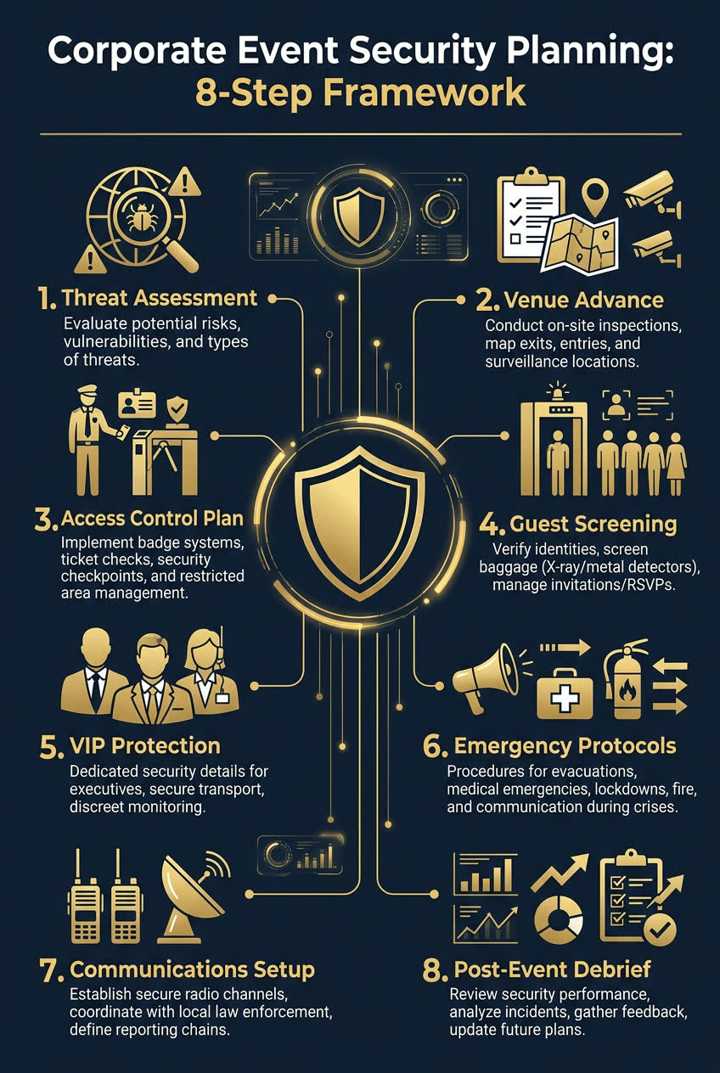
The 8-Step Corporate Event Security Framework
This framework has been refined through thousands of protective operations at the highest levels of government and adapted for corporate applications by AMERINE's team of former Secret Service agents.
!Corporate Event Security 8-Step Framework
Step 1: Threat Assessment
Before any security plan is developed, you need to understand what you're protecting against. A thorough event threat assessment evaluates:
- Attendee risk profiles: Are there C-suite executives, public figures, or controversial speakers who may attract targeted threats?
- Event visibility: Is the event public-facing, media-covered, or invitation-only?
- Location risks: What is the crime profile of the area? Are there nearby protest zones or competing events?
- Historical threats: Have previous events faced disruptions, protests, or security incidents?
- Current threat landscape: Are there active threats against the organization, its leadership, or its industry?
Step 2: Venue Advance
The venue advance is where the Secret Service methodology really shines. A professional advance includes:
- Complete walk-through of the venue including back-of-house areas
- Identification of all entry and exit points (including emergency exits)
- Mapping of "choke points" where crowd flow creates vulnerability
- Location of the nearest trauma center and fire station
- Assessment of existing venue security infrastructure (CCTV, alarms, locks)
- Identification of secure holding areas for VIPs
- Coordination with venue management on security protocols
- Communications testing (radio, cell, Wi-Fi reliability)
Step 3: Access Control Plan
Access control is the foundation of event security. Your plan should define:
- Credentialing system: Badges, wristbands, or digital check-in for different access levels
- Screening procedures: Bag checks, magnetometers, or visual screening at entry points
- Restricted areas: Backstage, green rooms, executive lounges with separate access
- Vehicle access: Loading dock security, valet screening, VIP vehicle staging
- Staffing positions: How many security personnel at each access point, with rotation schedules
Step 4: Guest Screening
For high-profile events, guest screening goes beyond checking invitations:
- Pre-event guest list review against threat databases
- Social media monitoring for attendees posting hostile intent
- Coordination with law enforcement on known threat actors
- Protocols for handling uninvited or flagged individuals
- Media credentialing and press area management
Step 5: VIP Protection
High-profile attendees require dedicated protection beyond the general event security plan:
- Assigned close protection officers for keynote speakers, board members, and VIP guests
- Separate VIP arrival and departure procedures (private entrances, staged vehicles)
- Secure holding rooms with advance security sweeps
- Movement plans within the venue (stage approaches, networking area transitions)
- Emergency evacuation routes specific to each VIP's location
Step 6: Emergency Protocols
Every event security plan must include detailed protocols for:
- Medical emergencies: AED locations, first responder positioning, hospital routes
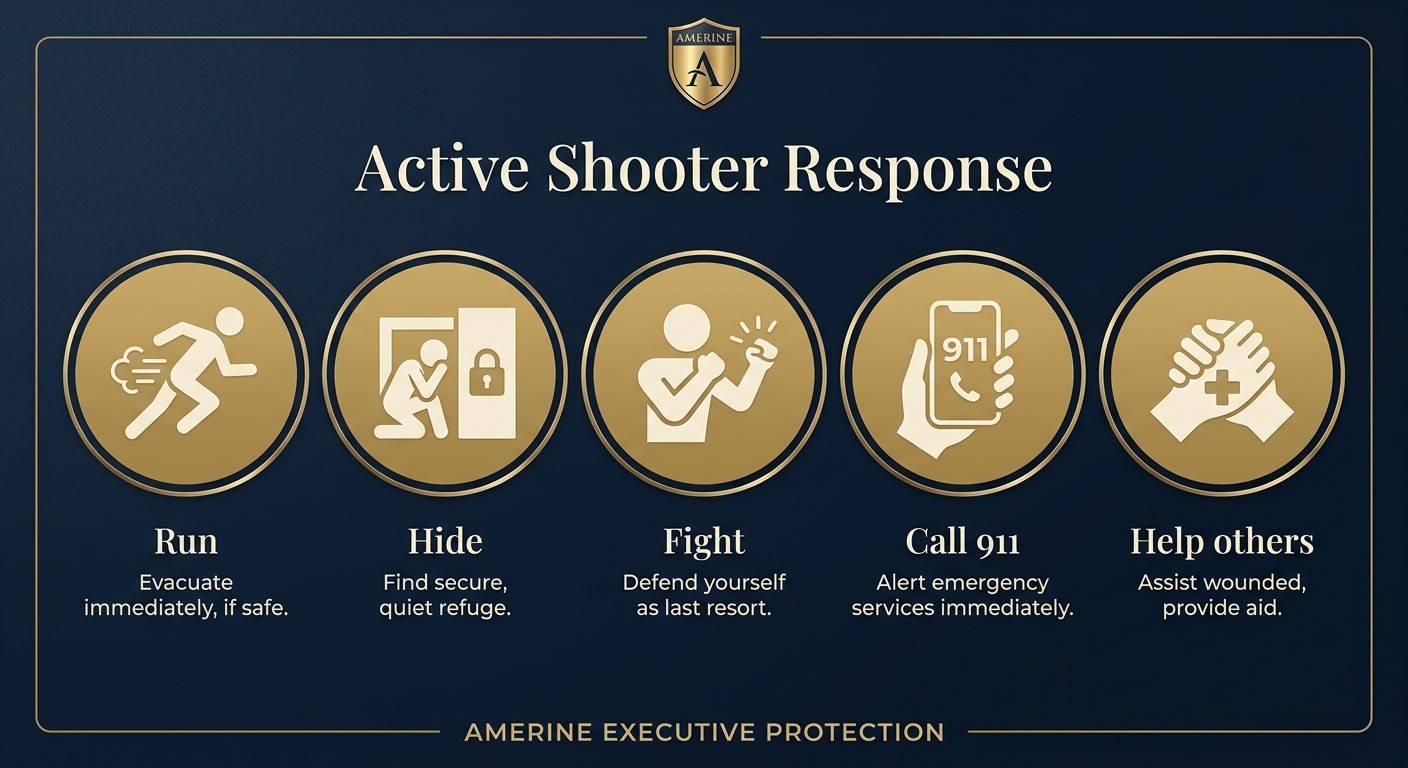
- Active threat response: Lockdown procedures, evacuation routes, safe rooms
- Fire evacuation: Coordination with venue fire systems, assembly points
- Weather emergencies: Shelter plans for outdoor or hybrid events
- Protest or disruption: De-escalation protocols, ejection procedures, law enforcement coordination
- Bomb threat: Evacuation procedures, search protocols, command post activation
Step 7: Communications Setup
Security communications are critical and often the first thing to fail under pressure:
- Dedicated radio channels for security team (separate from venue operations)
- Command post location with redundant communications
- Chain of command clearly defined — who makes the call to evacuate, lock down, or engage?
- Pre-programmed emergency contacts: local PD, fire, FBI, hospital
- Backup communication methods (cell, text, runner) if primary systems fail
- Real-time incident reporting system
Step 8: Post-Event Debrief
The debrief is the most overlooked — and most valuable — step in event security:
- Review of all incidents, near-misses, and observations
- Assessment of what worked and what needs improvement
- Guest and staff feedback on security experience
- Documentation for liability protection and future planning
- Updated threat assessment based on event intelligence
- Recommendations for future events
Common Corporate Event Security Mistakes
Mistake 1: Treating Event Security as an Afterthought
Security should be integrated into event planning from day one, not bolted on a week before. Advance planning, venue coordination, and threat assessment all require lead time.
Mistake 2: Relying Solely on Venue Security
Venue-provided security protects the venue's interests, not yours. They manage general crowd control and facility safety — not VIP protection, threat-specific response, or your organization's duty of care obligations.
Mistake 3: Visible Security That Creates the Wrong Atmosphere
Heavy-handed security with uniformed guards and visible weapons can ruin a corporate event's atmosphere. Professional event security is discreet, well-dressed, and integrated — guests should feel welcome, not surveilled.
Mistake 4: No Contingency Plans
"What if?" is the most important question in event security. What if a protest forms outside? What if a VIP receives a threat mid-event? What if there's a medical emergency during the keynote? Without pre-planned responses, you're improvising under pressure.
Scaling Security for Different Event Types
| Event Type | Typical Security Needs | Team Size |
|---|---|---|
| Board Meeting (10-20 people) | Access control, VIP protection, secure transportation | 2-4 operators |
| Executive Retreat (30-50 people) | Venue advance, access control, perimeter, medical | 4-8 operators |
| Corporate Conference (200-500 people) | Full framework, multiple access points, VIP details | 8-15 operators |
| Gala or Public Event (500+ people) | Complete deployment with command post, counter-surveillance | 15-30+ operators |
The AMERINE Approach to Corporate Event Security
At AMERINE, corporate event security is planned and executed using the same methodology our team leaders applied to presidential visits and major government events during their Secret Service careers. Every engagement includes:
- Formal threat assessment and venue advance
- Detailed operations order with contingency plans
- Dedicated close protection for VIP attendees
- Integrated communications and GSOC monitoring
- Professional, discreet operators in business attire
- Post-event debrief and documentation
Whether you're planning a board retreat for 15 or a shareholder gala for 1,500, we design security that is thorough, invisible, and perfectly calibrated to your event's tone and objectives.
Contact AMERINE for a confidential event security consultation, or call (281) 799-1877.