Why a Real Threat Assessment Is Non-Negotiable
Every serious executive protection program begins with a written threat assessment. Without one, every operational decision — number of agents, vehicle posture, residential coverage, travel protocols — is a guess. The threat assessment is the document that turns intuition into a defensible program.
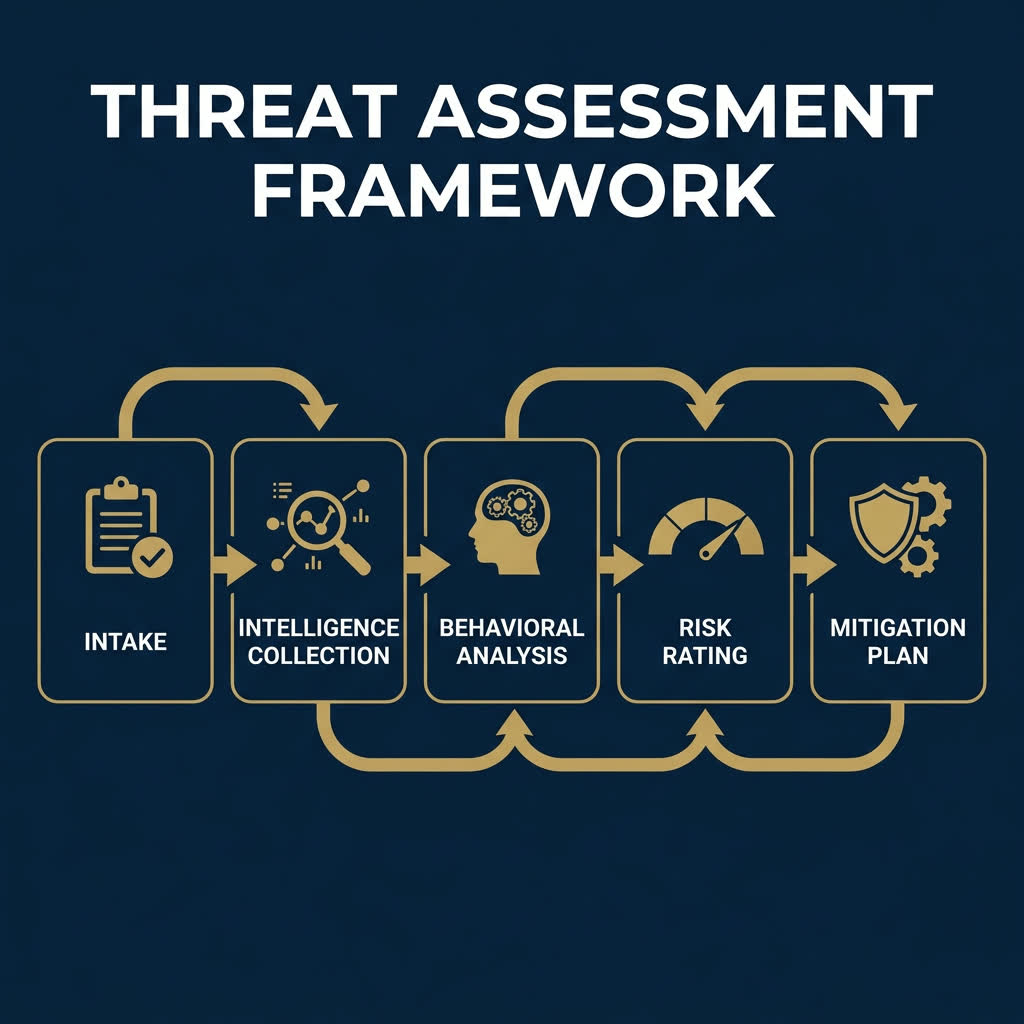
At AMERINE, our threat assessment process is built on the methodology used by the U.S. Secret Service and adapted for the realities of private-sector principals. This guide walks through the five phases.
Phase 1: Intake
Intake is a structured interview with the principal, the family office, the chief of staff, or the corporate security lead. It captures:
- Who the principal is — public profile, business activities, family situation, travel patterns.
- The principal's lifestyle — residences, vehicles, daily patterns, household staff, technology footprint.
- Any history of concerning communications, incidents, stalkers, disputes, or litigation.
- The principal's tolerance for visible security and willingness to modify behavior.
- The decision-maker and the program goals.
A weak intake produces a weak assessment. We invest the time here because everything downstream depends on it.
Phase 2: Intelligence Collection
Intelligence collection is structured research. It includes:
- Open-source intelligence (OSINT) on the principal, family, and business.
- Social media exposure analysis — what is publicly findable about the principal, the residences, the schedule, and the children.
- Public records review — addresses, vehicles, business filings, litigation history.
- Review of any prior incidents, communications, or persons of concern.
- Where appropriate, structured interviews with prior security providers, household staff, or executive assistants.
The goal is to build a complete picture of how the principal looks to a potential attacker.
Phase 3: Behavioral Analysis
Behavioral analysis is where threat assessment becomes a discipline rather than a checklist. It draws on the same body of research used by federal threat assessment programs and asks:
- Are there individuals exhibiting concerning behavior toward the principal? Who are they, and where on the pathway to violence are they?
- What grievances, ideologies, or motivations could drive an attack?
- What are the principal's specific vulnerabilities — patterns, predictability, exposure points?
- What insider risks exist within the household, business, or extended family?
Behavioral analysis is the bridge between data and decisions.
Phase 4: Risk Rating
The output of the first three phases feeds into a structured risk rating. AMERINE rates risk across multiple dimensions:
- Likelihood — how probable is a hostile act in the next 12 months?
- Severity — what is the worst-case outcome if it occurs?
- Vulnerability — how exposed is the principal to that scenario?
- Capability — does any identified threat have the means to execute?
The risk rating is the language the program is designed in. Without it, every recommendation is opinion.
Phase 5: Mitigation Plan
The mitigation plan is the deliverable. It is written, structured, and prioritized. A real plan includes:
- Specific recommendations across personal protection, residential security, transportation, travel, and digital exposure.
- Sequencing — what to do this week, this quarter, this year.
- Estimated effort and investment for each recommendation.
- A documented review cadence for re-assessing the plan as the threat picture evolves.
A mitigation plan is not a sales pitch. It is a defensible roadmap that can be reviewed by the principal, the family office, the corporate board, or — if necessary — outside counsel.
How AMERINE Delivers Threat Assessments
Every AMERINE threat assessment is led by Scott Jones, a former U.S. Secret Service Special Agent. The deliverable is a written report, presented in person, with clear next steps. The assessment stands on its own — you can take it to any provider, including ones that are not AMERINE.
Contact AMERINE for a confidential threat assessment consultation.