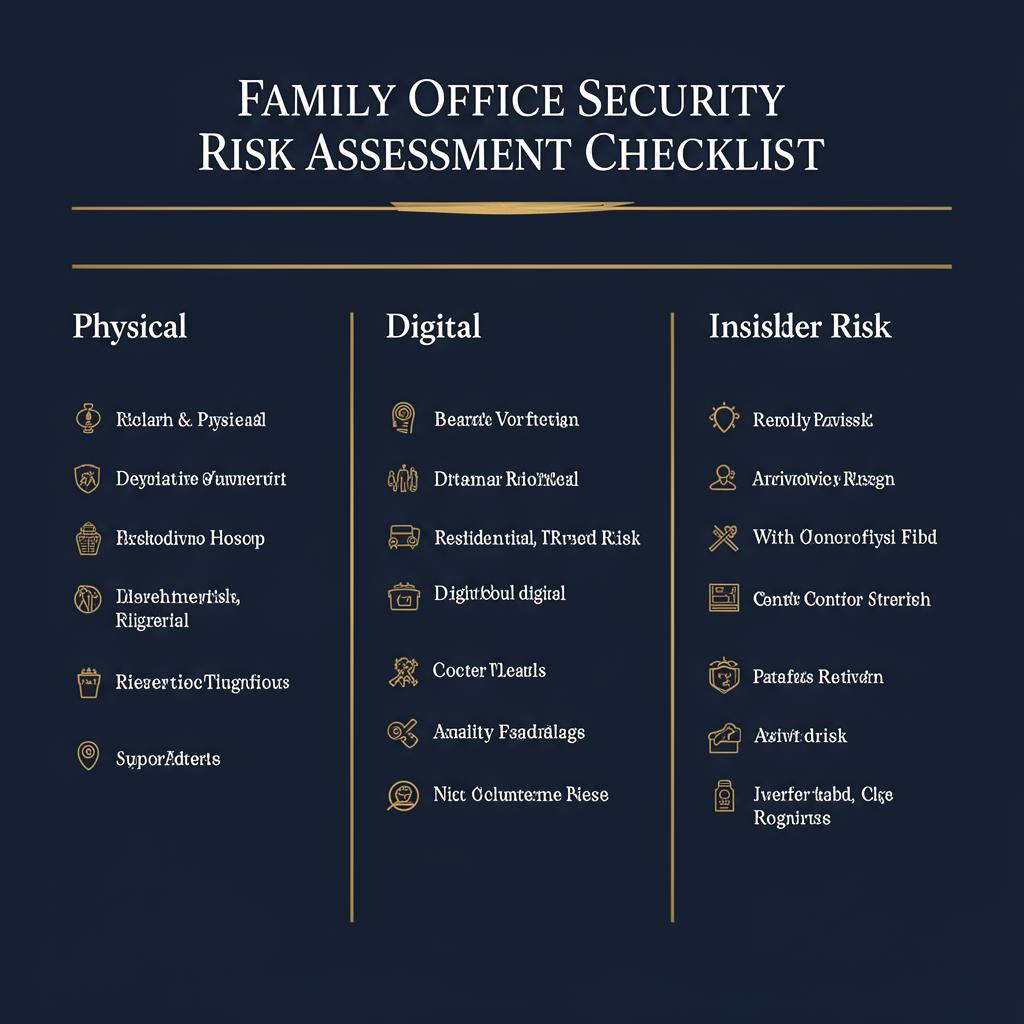
Why Family Offices Need an Integrated Risk View
When we meet family offices, most already have credible pieces in place: a monitored alarm system, residential staff they've worked with for years, a cyber vendor running endpoint protection, and a travel agent who books the jet. What's usually missing is a single, clear view of risk across the principals, residences, staff, travel program, and digital footprint.
Deloitte's 2024 family-office survey found that 43% of family offices had experienced a cyberattack in the prior 12 to 24 months, while 31% had no cybersecurity strategy. That gap matters, and it matches what we see in our own work: individual components are strong, but the connections between them are weak.
This checklist is the framework we use to assess that connective tissue across five domains.
1. Physical Risk
For a family office, three places account for the concentration of physical risk: the principal, the residence, and the predictable routes connecting them.
- Principal profile: Public visibility, philanthropy footprint, business controversy, and family member exposure. The higher and more searchable the profile, the more posture is required.
- Predictable patterns: Recurring restaurant nights, weekly board meetings at the same office, school drop-offs at the same time. Pattern is the single most-exploited weakness for opportunistic and targeted actors alike.
- Event exposure: Galas, openings, weddings, public appearances. Visible, scheduled, and publicized in advance.
- Travel-day risk: Airport and FBO arrivals and departures, where the principal is publicly identifiable and on a known schedule.
A baseline physical assessment names each of these and assigns posture: monitored, advance work only, or covered detail.
2. Digital Risk
A principal's digital footprint is wider than most family offices realize. It spans several distinct areas:
- The principal's own accounts (email, social, SMS, financial).
- Adult children's social media, typically the single largest source of exposure.
- Family-office staff accounts that touch principal information.
- Vendors who hold travel itineraries, calendar data, household-staff schedules, and financial documents.
- Publicly searchable records: corporate filings, property records, philanthropic disclosures, and aggregated data-broker profiles.
Repeated FBI warnings about generative AI impersonation cover deepfake video, AI voice cloning, and convincing text impersonation of executives. Endpoint protection no longer serves as a meaningful baseline. What matters in practice is this: can your staff verify a request that appears to come from the principal?
Checklist items:
- Documented out-of-band verification protocol for any wire, schedule change, or sensitive request that appears to come from the principal.
- Data-broker removal program in place and recurring.
- Adult-children social-media briefing on the calendar at least annually.
- Vendor inventory: who holds what data, and what is the breach-notification expectation.
3. Residential Risk
Alarms are only a baseline for a family-office residence. A proper security assessment covers:
- Physical layers: Perimeter, exterior lighting, access control, interior intrusion detection, panic infrastructure, and safe-room readiness.
- Staff vetting and access: Background checks, NDAs, key and code management, and a documented offboarding protocol for departed staff.
- Vendor and service access: Pool, landscaping, household maintenance, and contractor management. Most residential exposure comes through trusted access, not breach.
- Family-side culture: Door discipline, package handling, social-media discipline on property photos, and rules around staff phones.
- Multiple-property posture: How the same standard is applied across primary, secondary, and seasonal residences, including the property that is "closed" most of the year.
4. Travel Risk
Travel is where the principal is most identifiable, most predictable, and most exposed. The travel-security checklist covers:
- Pre-trip intelligence brief on destination, route, accommodations, and current threat picture.
- Vetted secure transportation with named driver and pre-cleared vehicle.
- FBO and commercial-airport handling discipline: discreet meet-and-greet, ramp-side movement, baggage chain of custody.
- Hotel arrival protocol: pre-keyed, side-entry where appropriate, room-floor and adjacent-room awareness.
- Communications: encrypted channels for itinerary, accountable home-side contact, check-in cadence.
- Medical contingency: known facility, repatriation coverage, named in-country medical liaison if warranted.
For families with recurring international travel, this should be a standing program, not a per-trip scramble.
5. Insider Risk
This is the most uncomfortable category, and the one where most family offices underinvest. Insider risk covers:
- Staff lifecycle: Depth of background investigations at hire, periodic re-vetting (especially after major life events), and disciplined offboarding.
- Access governance: Who can see calendar, travel, financial, and family details, and who cuts off that access when roles change.
- Behavioral indicators: A documented protocol for raising concerns about a long-tenured staff member without rupturing trust over a false alarm.
- Concentration risk: A single household manager, family-office executive, or longtime driver who holds disproportionate access to principals and information.
Managing insider risk takes disciplined access, regular reviews, and a workplace standard that treats security hygiene as part of the job rather than an accusation. Suspicion won't solve it.
Putting It Together
A serviceable family-office security assessment produces three things:
- A current-state map across the five domains, with each item rated.
- A prioritized 12-month remediation plan with named owners.
- A standing review cadence, usually semi-annual, so the picture stays current.
Our assessments for family offices start as a one-time engagement. Where warranted, we then move the recurring components, including intelligence, travel coverage, and residential periodic review, into a standing arrangement.
Contact us or call (281) 799-1877 to schedule a private family-office assessment conversation.
---
This article is general security planning guidance and is not legal, insurance, or fiduciary advice.