Why Most Travel Policies Fail
Most executive travel security policies fail because one person wrote them, they were approved once, and nobody ever tested them. The gap between the policy and what people actually do becomes clear immediately when a real incident hits: a flight cancellation, a hotel evacuation, a security event near the meeting site, or a sudden itinerary change.
A travel security policy that works is short, clear on roles, tiered, and rehearsed.
Scope: Who Is Covered
Define this explicitly:
- The CEO and named executive officers.
- The board on company travel.
- Key personnel by named role (general counsel, head of strategy, etc.).
- Family members traveling with covered executives on company-related trips.
- Contractors and advisors traveling on the company's behalf into elevated geographies.
Ambiguity here leads directly to the "we didn't think that trip counted" failure mode.
Travel Tiers
A tiered classification keeps the policy practical:
- Tier 1: Domestic low-risk. Standard booking, no additional security required.
- Tier 2: Domestic elevated. Pre-travel briefing required, triggered by public visibility, M&A, layoffs, litigation, or controversy.
- Tier 3: International standard. Pre-travel intelligence brief and 24/7 monitoring required.
- Tier 4: International elevated or high-risk. Secure transportation and protective agent required, with on-the-ground intelligence.
Each tier defines what is required, who decides, and who owns delivery.
Pre-Travel Requirements
The pre-travel layer is where most incidents are prevented. For Tier 2 and above:
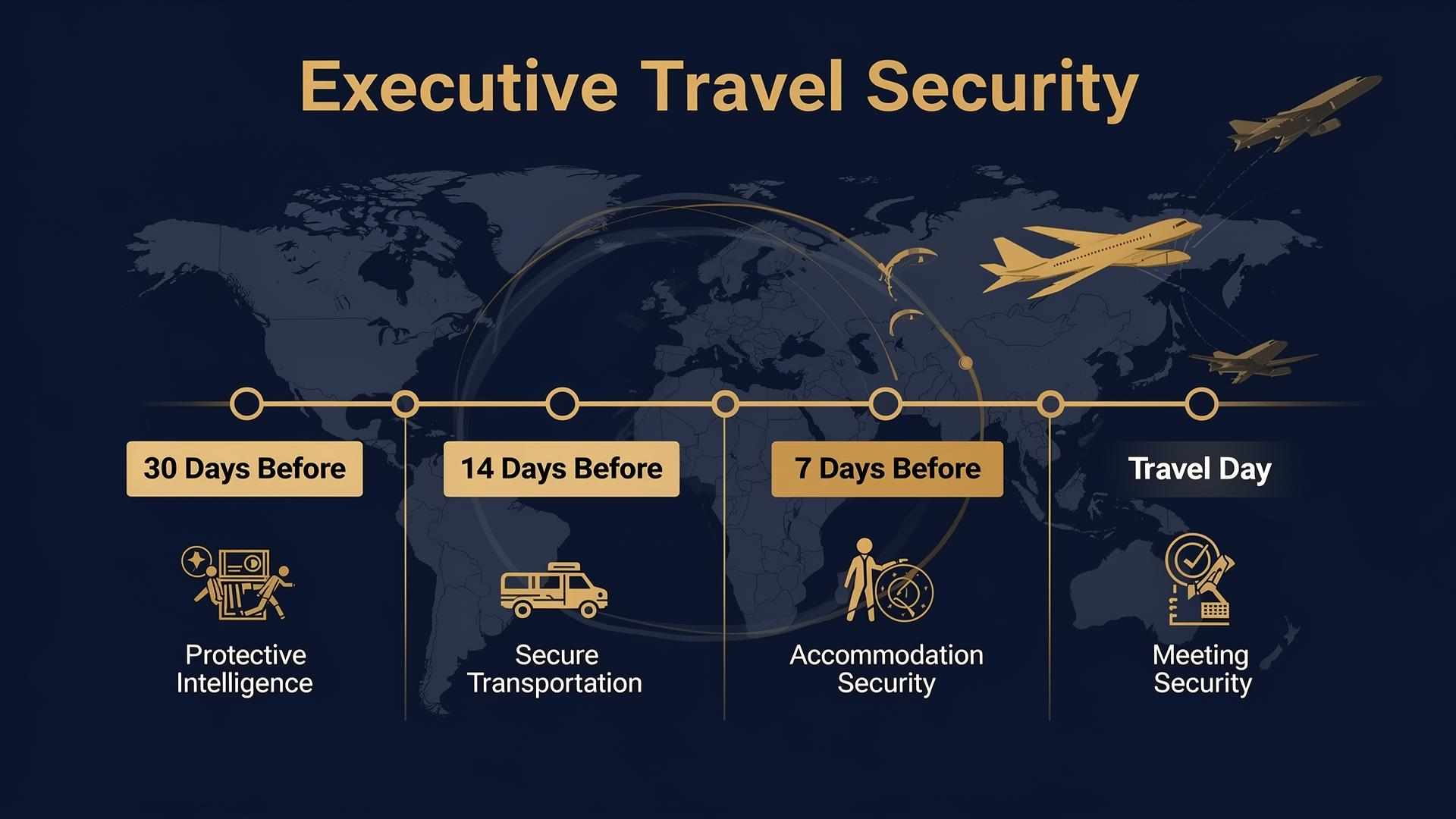
- Itinerary submitted to security at least seven business days in advance.
- Country or city threat briefing for Tier 3+.
- Hotel, route, FBO, and meeting-site review for Tier 3+.
- Medical, insurance (including K&R where applicable), and evacuation contacts confirmed.
- Family member coordination if traveling together.
In-Country Standards
The standards executives follow once they land matter more than the standards on paper:
- Two-channel confirmation for any in-trip change to payment, route, itinerary, host, or vendor.
- Designated check-in cadence with a home-side accountable person.
- Secure transportation for all venue, airport, and external meeting movements at Tier 3+.
- No public posting of location, itinerary, or vehicle/aircraft details during the trip.
Communication and Escalation
Every travel policy should define, in writing:
- The 24/7 emergency line.
- The escalation chain (security → general counsel → CEO → board).
- Decision authority for cancellation, rerouting, and evacuation: pre-assigned, not improvised.
- Reporting requirements after incidents and near-misses.
This is the single most important section of any travel policy. It is also the most commonly missing one.
Medical, Political, and Civil Considerations
Beyond the security envelope, executive travel intersects with:
- Medical: nearest Level I trauma center, concierge medicine, prescription coverage.
- Political: election windows, protest activity, regulatory exposure in destination country.
- Civil unrest and weather: contingency for sudden disruption.
- Cultural and legal: jurisdictional rules on photography, data, devices, and protective agents.
For Tier 3+ travel, these are part of the pre-travel brief, not afterthoughts.
Annual Test
If you haven't tested your policy, it isn't a policy. The security committee should put it through a tabletop exercise once a year:
- Medical evacuation from a Tier 3 city.
- Political event disrupting a board offsite.
- Impersonation attempt during an executive's trip.
- Hotel evacuation during a major customer event.
You're looking for gaps before a real event exposes them, not grading the response.
A Final Note
Your executive travel security policy can be short, but it needs clear language, tiers, assigned owners, and testing. Companies that handle travel security well apply the same approach they use for financial controls: a defined process, named owners, and a regular review cycle.
Request an executive travel policy review →
Related: Travel security, Executive threat briefing, Secure transportation, Duty of care, International executive protection.
---
General planning guidance, not legal, HR, or insurance advice. Coordinate policy adoption with general counsel and HR.