Executive protection is one of the most demanding and rewarding careers in the security industry. But becoming a qualified EP professional requires far more than physical strength or firearms proficiency — it demands a unique combination of tactical training, intelligence analysis, interpersonal skills, medical knowledge, and the judgment to make split-second decisions under extreme pressure.
Whether you're considering a career in executive protection, evaluating a firm's training standards, or simply want to understand what separates elite operators from the rest, this guide covers every aspect of EP training requirements.
The Foundation: Background and Prerequisites
Most elite executive protection professionals come from one of three backgrounds:
Government Protective Services
- U.S. Secret Service (Presidential Protective Division, field offices)
- Diplomatic Security Service (State Department)
- U.S. Capitol Police protective details
- Military protective operations (CID, NCIS, OSI protective details)
Military Special Operations
- Army Special Forces, Rangers, Delta Force
- Navy SEALs and SWCC
- Marine Force Recon and MARSOC
- Air Force Special Tactics and PJ
Federal Law Enforcement
- FBI protective operations
- DEA special operations
- U.S. Marshals Service fugitive operations
- ATF special response teams
At AMERINE, we recruit exclusively from these backgrounds because they provide the decision-making framework, operational discipline, and real-world experience that cannot be replicated in any training course.
Core Training Requirements
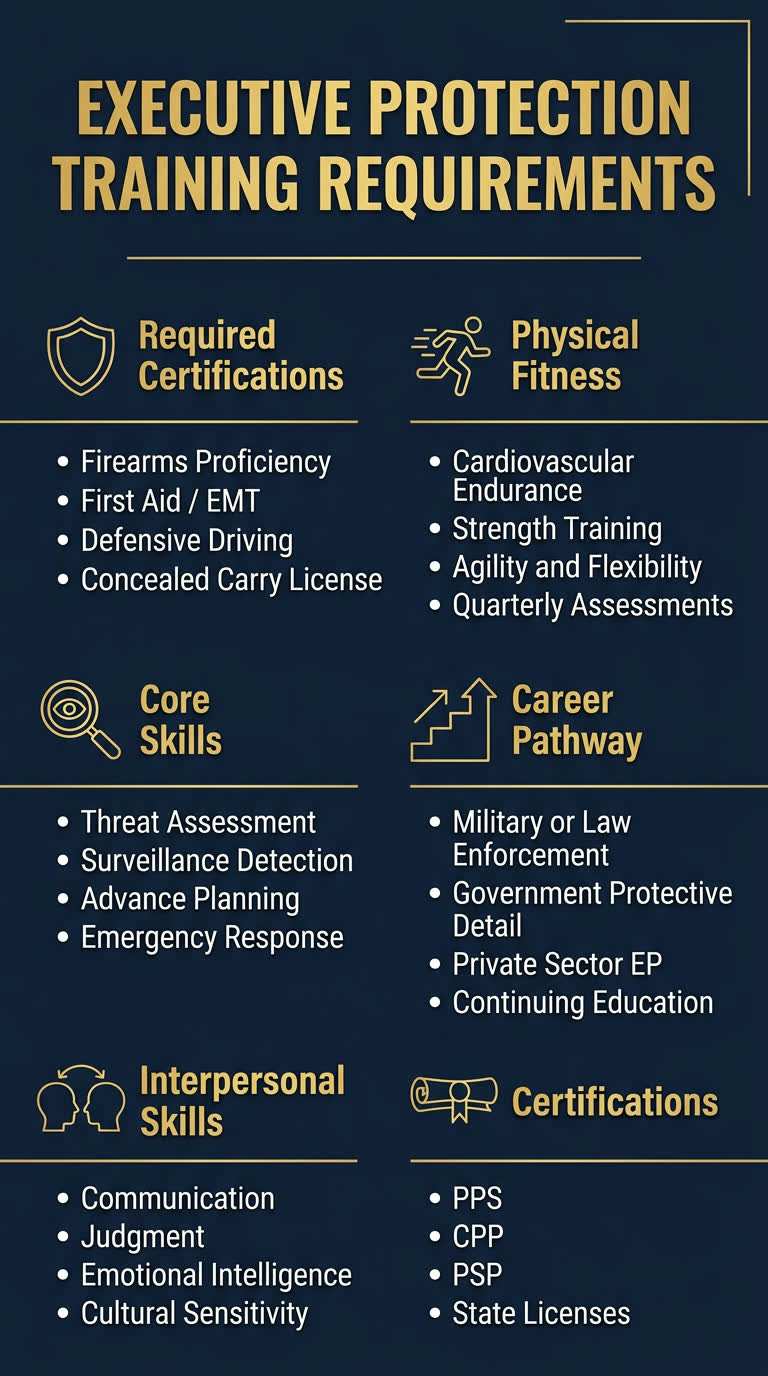
1. Firearms Proficiency and Qualification
Armed executive protection requires comprehensive firearms training:
- Handgun proficiency (primary and backup weapons)
- Qualification courses aligned with federal law enforcement standards
- Shoot/don't-shoot decision training using realistic scenarios
- Low-light and confined-space shooting
- Weapon retention and disarming techniques
- State-specific concealed carry licensing and reciprocity knowledge
- Annual re-qualification requirements (minimum quarterly live-fire training)
At AMERINE, our operators maintain firearms proficiency that meets or exceeds Secret Service qualification standards — not the minimum state requirements that many firms accept.
2. Emergency Medical Training
Medical emergencies are far more likely than violent encounters in EP work:
- Current EMT or first responder certification (minimum)
- Tactical Combat Casualty Care (TCCC) or equivalent
- AED and CPR certification
- Trauma care: tourniquet application, wound packing, chest seals
- Medical kit management and medication awareness
- Evacuation procedures and hospital route planning
- Regular recertification and scenario-based medical training
3. Defensive and Evasive Driving
Secure transportation is integral to executive protection:
- Defensive driving certification from an accredited program
- Evasive driving techniques: J-turns, PIT maneuvers, ramming protocols
- Route planning and alternate route identification
- Vehicle counter-ambush techniques
- Motorcade and multi-vehicle movement protocols
- Vehicle inspection and IED awareness
- Driving in adverse conditions and unfamiliar environments
4. Advance Planning and Site Security
This is what separates EP from bodyguard work:
- Advance methodology: pre-visit site surveys and security assessments
- Arrival and departure planning with primary and alternate routes
- Venue security evaluation: entry/exit points, cover positions, evacuation routes
- Hotel advance: room selection, floor plans, emergency procedures
- Hospital and safe haven identification and pre-coordination
- Communication planning with local law enforcement and venue security
- Written advance reports and operational briefings
5. Protective Intelligence and Threat Assessment
Intelligence drives protection — not reaction:
- Open-source intelligence (OSINT) collection and analysis
- Social media monitoring for threat indicators
- Behavioral threat assessment frameworks (Secret Service model)
- Pre-travel intelligence briefings for domestic and international movements
- Surveillance detection routes (SDR) and counter-surveillance techniques
- Coordination with intelligence analysts and security operations centers
- Dark web monitoring awareness
6. Physical Fitness Standards
EP work is physically demanding:
- Cardiovascular endurance for extended protective details (12-16 hour shifts)
- Strength training for physical intervention capability
- Flexibility and agility for dynamic movement in crowds
- Heat and cold weather acclimatization for outdoor details
- Swim qualification for waterside protective operations
- Regular fitness assessments (recommended quarterly)
Interpersonal and Professional Skills
Technical skills are necessary but insufficient. Elite EP requires:
Communication
- Clear, concise radio communications using standardized protocols
- Professional interaction with clients, their families, staff, and associates
- De-escalation and verbal crisis intervention
- Written reporting and documentation
- Multilingual capability (valuable for international operations)
Judgment and Decision-Making
- Threat level assessment in real-time — escalation vs. de-escalation
- Use-of-force continuum understanding and application
- Balancing security with client lifestyle and preferences
- Media management and public interaction protocols
- Cultural sensitivity for international operations
Emotional Intelligence
- Working in intimate family environments with discretion
- Managing client stress and anxiety during threat situations
- Maintaining professional boundaries while building trust
- Adapting communication style to different client personalities
Certifications and Professional Development
Recommended Certifications
- PPS (Personal Protection Specialist) — Executive Protection Institute
- CPP (Certified Protection Professional) — ASIS International
- PSP (Physical Security Professional) — ASIS International
- CPOI (Certified Protection Officer Instructor) — IFPO
- State-specific armed security licenses and carry permits
Continuing Education
- Annual firearms re-qualification
- Biannual medical recertification (EMT/first responder)
- Annual defensive driving refresher
- Industry conferences (ASIS International, ESI symposiums)
- Legal updates on use of force, privacy laws, and carrying regulations
- Technology training: GPS tracking, communication systems, counter-surveillance equipment
Career Pathway: From Government to Private EP
The typical progression for elite EP professionals:
Step 1: Foundation (Years 1-5)
Military service or law enforcement career. Develop firearms, medical, driving, and tactical skills in a structured training environment with real operational experience.
Step 2: Protective Experience (Years 5-10)
Assignment to a government protective detail (Secret Service, DSS, military PSD). Learn advance planning, protective intelligence, and principal-centric operations.
Step 3: Specialization (Years 10-15)
Develop specialized skills: international operations, counter-surveillance, protective intelligence analysis, or team leadership. Build professional network across government and private sectors.
Step 4: Private Sector Transition (Years 15+)
Transition to private executive protection with a reputable firm. Apply government-level methodology to UHNW, corporate, and celebrity protection programs.
What to Look for When Hiring EP Professionals
If you're hiring executive protection — not pursuing a career — here's what to verify:
- Specific government or military protective experience (not just "military veteran")
- Current firearms qualification and state licensing
- Current medical certifications (not expired)
- Verifiable references from previous protection employers
- Professional liability insurance coverage
- Clean background and drug screening results
- Demonstrated advance planning methodology
- Professional demeanor and appearance
Why AMERINE's Training Standards Matter
At AMERINE, every operator meets the training standards outlined in this guide — because our operators lived these standards during careers in the Secret Service, military special operations, and federal law enforcement. We don't train civilians to become protectors; we recruit professionals who have already spent 15+ years in government protective operations and bring them into the private sector.
Our continuing training program ensures operators maintain and expand their skills throughout their career with AMERINE, including quarterly firearms qualification, annual medical recertification, and ongoing professional development.
Contact AMERINE for a confidential consultation about executive protection services backed by the training and experience that sets the industry standard.