The Perimeter Moved
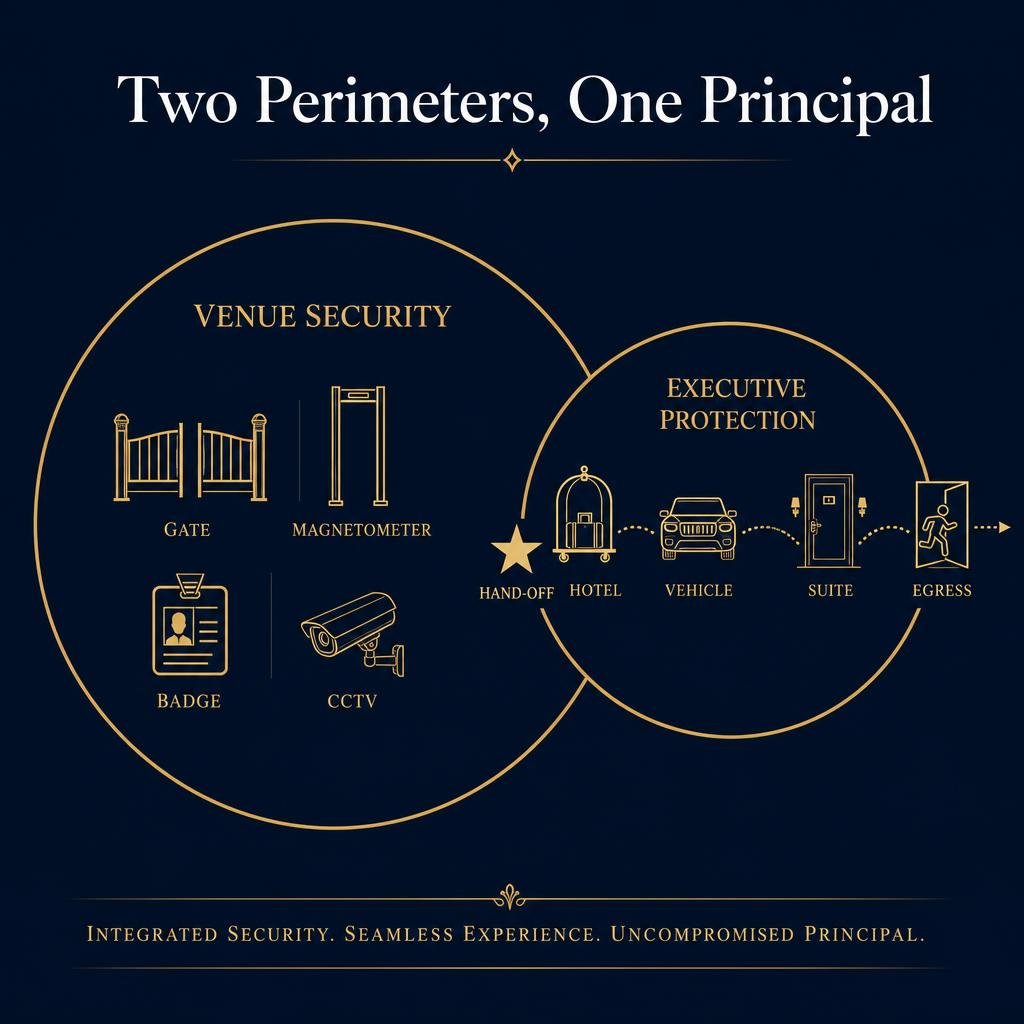
For most of the modern history of executive protection, the perimeter was physical. Residence, vehicle, office, venue. The principal moved between hardened spaces, and the protective detail's job was to manage the transitions.
That perimeter is still there. But it is no longer the only one — and for many of our clients, it is no longer the one most often attacked. The first contact a hostile actor has with an executive today is almost always digital: a leaked home address, a fake social account, a cloned voice on the family office line, a deepfake video circulating before legal can respond.
The FBI has issued repeated public warnings that criminals are using generative AI to produce believable text, images, voice clones, and videos for impersonation and fraud. The pace has accelerated dramatically in the last 18 months. Digital executive protection is no longer a specialty discipline — it is part of every program we run.
What Digital Executive Protection Actually Means
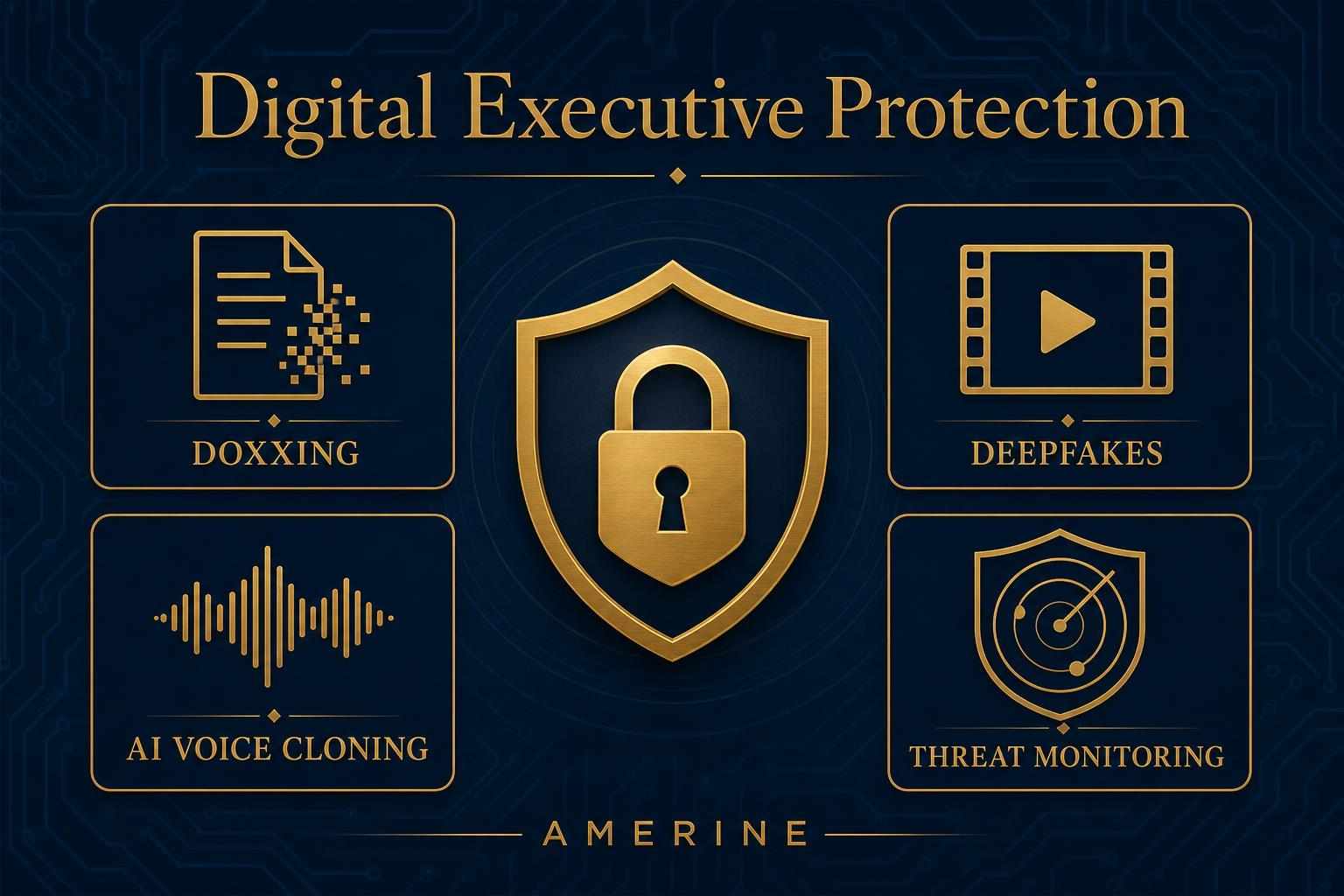
The term gets used loosely. For AMERINE, digital executive protection covers four distinct workstreams:
- Exposure reduction — actively shrinking the principal's and family's findable footprint.
- Threat monitoring — watching the channels where threats emerge before they reach the principal.
- Impersonation defense — detecting and responding to fake accounts, cloned voices, and deepfake content.
- Incident response — when something happens, who gets called, in what order, and with what authority.
Each one has to function on its own and integrate with the physical detail. A digital threat that requires a residential posture change has to flow to the protective team in minutes, not days.
Doxxing and Exposure Reduction
Doxxing is the deliberate publication of a person's private information — home address, family members, school names, vehicle plates, daily routine — usually for the purpose of inviting harassment or worse.
The defense begins long before a doxxing campaign:
- Data broker removal: The principal's name, address, phone, and relatives are scrubbed from the major people-search aggregators. This is ongoing work, not a one-time project.
- Property records: Where state law permits, residences are held in an LLC or trust so the principal's name does not appear in county tax records.
- Family hygiene: Spouses and adult children get the same scrubbing treatment. Doxxers chase the easiest link.
- Social media audit: Geotagged photos, school logos in family pictures, license plates in driveway shots — all of it is reviewed.
The objective is not invisibility. It is friction. A hostile actor who has to spend forty hours assembling a target package will, in most cases, choose a different target.
Threat Monitoring and Protective Intelligence
The protective intelligence cycle does not begin with a threat. It begins with a baseline.
- Surface, deep, and dark web monitoring: The principal's name, title, family members, residences, and aliases are watched continuously across forums, marketplaces, paste sites, and social platforms.
- Sentiment and escalation tracking: A single hostile post is noise. A pattern of escalating language from the same actor across multiple platforms is a signal.
- Triggering events: Earnings announcements, layoffs, litigation, regulatory action, and public controversy are inflection points. Monitoring posture tightens automatically around them.
When a credible threat surfaces, the response is coordinated with the protective detail, legal, communications, and where appropriate, law enforcement. For the full response framework, see Responding to a Credible Threat.
Deepfakes and AI Voice Cloning
This is the fastest-moving category. A few months ago, deepfake video required hours of source material and visible artifacts. Today, a serviceable voice clone can be built from thirty seconds of a podcast appearance.
What we are seeing in the field:
- Vendor fraud: A cloned CEO voice on a call to the controller, authorizing an "urgent" wire transfer. This is the highest-frequency attack right now.
- Family-side fraud: A cloned voice calling a spouse or parent claiming the principal has been in an accident, a kidnapping, or arrest abroad — followed by a payment demand.
- Reputational deepfakes: Manufactured video or audio designed to embarrass the principal, move a stock price, or derail a deal.
Defenses are layered:
- Out-of-band verification: A pre-agreed verbal challenge phrase between the principal, family, and key staff. No wire, no movement, no public statement without it.
- Family briefing: Spouses, parents, and adult children are walked through current scam patterns. The "your son has been in an accident" call should bounce off a trained family.
- Rapid takedown channels: Direct working relationships with platform trust-and-safety teams so a deepfake reaches takedown in hours, not weeks.
- Voice and biometric controls on accounts where the financial institution supports them.
Incident Response
When something digital actually happens, the question is not technical — it is procedural. Who gets called, in what order, and with what authority?
For our clients, the answer is documented before it is needed:
- The principal is informed by the lead protector or chief of staff, not by a social media notification.
- Legal and communications are looped in within thirty minutes for anything that has the potential to go public.
- Evidence is preserved before any takedown request is filed — screenshots, URLs, timestamps, archive captures.
- The physical posture is reassessed: does the digital threat change residential, travel, or event security for the next 72 hours?
- Law enforcement engagement is a decision made by the principal with legal counsel, not a default.
The Family Office Angle
For UHNW families and family offices, digital executive protection is harder than for a public-company CEO — because the family is more distributed and the financial controls are sometimes less industrialized.
Deloitte's family office research has found that 43% of family offices experienced a cyberattack in the prior 12 to 24 months, and 31% had no cybersecurity strategy in place. That is the gap our work fills on the family-office side: turning ad-hoc digital protection into a documented program with named owners and tested procedures.
What Good Looks Like
A mature digital executive protection program is invisible to the principal most of the time. The signs that it is working are negative: the cloned-voice wire request that the controller stops at the door, the doxxing campaign that fizzles because the home address is not findable, the deepfake video that hits a takedown queue before it crosses 10,000 views.
When it is not working, the signs are loud — and by then, the physical detail is responding to something the digital perimeter should have caught first.
How AMERINE Engages
We do not sell software. We coordinate the program: exposure reduction, monitoring, family briefings, incident response, and integration with the physical protective detail. Where third-party tools or vendors are required, we manage them on the principal's behalf.
If you want a baseline assessment of your digital perimeter, contact us or call (281) 799-1877.
---
This article is general information about digital exposure and protective intelligence and is not legal, cybersecurity, or law enforcement advice. Specific incidents should be reviewed with qualified legal counsel and, where appropriate, federal law enforcement.